Buy buylikes.be ?
We are moving the project
buylikes.be .
Are you interested in purchasing the domain
buylikes.be ?
domain@kv-gmbh.de · 0541-91531010
Buy buylikes.be ?
Can hydrogen bonding occur between hydrogen fluoride (HF) and water (H2O)?
Yes, hydrogen bonding can occur between hydrogen fluoride (HF) and water (H2O). Both HF and water molecules have hydrogen atoms bonded to highly electronegative atoms (fluorine and oxygen, respectively), creating a partial positive charge on the hydrogen atoms. This allows for hydrogen bonding to occur between the partially positive hydrogen atoms of HF and the partially negative oxygen atoms of water. Therefore, HF and water can form hydrogen bonds with each other. **
Why is there no hydrogen bonding in HI?
There is no hydrogen bonding in HI because hydrogen bonding occurs between hydrogen and highly electronegative elements like oxygen, nitrogen, or fluorine. In HI, hydrogen is bonded to iodine, which is less electronegative than oxygen, nitrogen, or fluorine. Therefore, the hydrogen in HI does not have a strong enough partial positive charge to form hydrogen bonds with other molecules. **

Similar search terms for Hydrogen bonding
Top-Angebote
Products related to Hydrogen bonding:
-
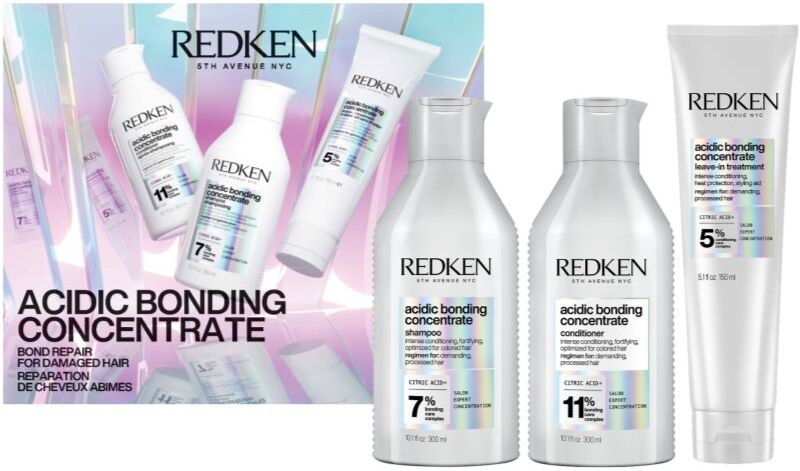
Redken Acidic Bonding Concentrate coffret cadeau effet régénérantRedken Acidic Bonding Concentrate, , Baumes et lotions pour cheveux pour femme, Tout ce dont vous avez besoin pour obtenir de beaux cheveux réuni dans un seul emballage. Le coffret cosmétique Redken Acidic Bonding Concentrate renferme non pas un mais plusieurs produits qui permettent de créer ou d’enrichir votre routine capillaire du quotidien. Ce coffret rempli de soins capillaires fera votre bonheur ou celui de vos proches si vous leur offrez un cadeau. L'ensemble contient: Redken Acidic Bonding Concentrate shampoing fortifiant pour cheveux affaiblis 300 ml Redken Acidic Bonding Concentrate après-shampoing régénération intense 300 ml Redken Acidic Bonding Concentrate soin fortifiant sans rinçage 150 ml Le produit : pour les cheveux abîmés pour les cheveux colorés pour les cheveux blonds et décolorés garantit aux cheveux un aspect naturel et les garde en bonne santé protège contre les agressions extérieures régénère et nourrit les cheveux laisse vos cheveux magnifiquement brillants et pleins de vitalité renforce la fibre capillaire Mode d’emploi : Utilisez chaque produit contenu dans le coffret cosmétique en respectant les instructions fournies dans le mode d’emploi.79,80 €*Shipping: 3,45 €Secure redirect to the provider
-
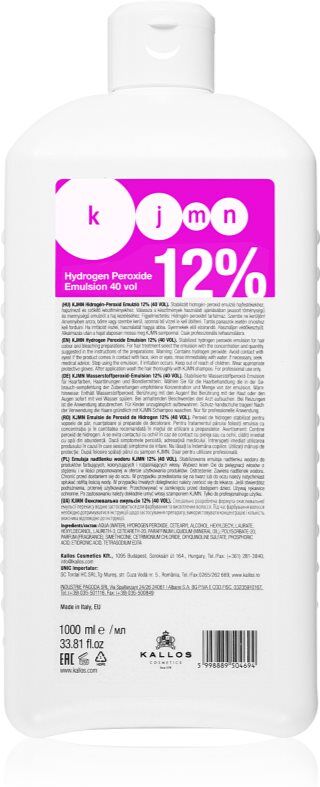
Kallos KJMN Professional Hydrogen Peroxide révélateur 12% 40 Vol. à usage professionnel 1000 mlKallos KJMN Professional Hydrogen Peroxide, 1000 ml, Émulsions activatrices pour femme, Obtenez un résultat parfait lorsque vous vous teintez les cheveux. L’émulsion activatrice Kallos KJMN Professional Hydrogen Peroxide fait fonction d’agent oxydant ou de révélateur lors des colorations. Lorsqu’elle est utilisée dans les bonnes proportions avec une coloration permanente, elle permet de couvrir uniformément les cheveux, d’accentuer nettement la teinte et son éclat et, de ce fait, d’obtenir un résultat plus intense. Grâce à son action sur la consistance du mélange colorant, elle garantit également une application plus précise. Le produit : agit comme agent oxydant lors de la coloration des cheveux Mode d’emploi : Pour usage professionnel uniquement.7,20 €*Shipping: 3,45 €Secure redirect to the provider
-
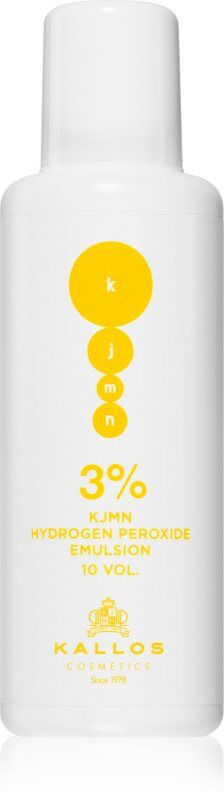
Kallos KJMN Professional Hydrogen Peroxide révélateur 3% 10 Vol. à usage professionnel 100 mlKallos KJMN Professional Hydrogen Peroxide, 100 ml, Émulsions activatrices pour femme, Obtenez un résultat parfait lorsque vous vous teintez les cheveux. L’émulsion activatrice Kallos KJMN Professional Hydrogen Peroxide fait fonction d’agent oxydant ou de révélateur lors des colorations. Lorsqu’elle est utilisée dans les bonnes proportions avec une coloration permanente, elle permet de couvrir uniformément les cheveux, d’accentuer nettement la teinte et son éclat et, de ce fait, d’obtenir un résultat plus intense. Grâce à son action sur la consistance du mélange colorant, elle garantit également une application plus précise. Le produit : agit comme agent oxydant lors de la coloration des cheveux Mode d’emploi : Pour usage professionnel uniquement.2,40 €*Shipping: 3,45 €Secure redirect to the provider
-
Kallos KJMN Professional Hydrogen Peroxide révélateur 12% 40 Vol. à usage professionnel 150 mlKallos KJMN Professional Hydrogen Peroxide, 150 ml, Émulsions activatrices pour femme, Obtenez un résultat parfait lorsque vous vous teintez les cheveux. L’émulsion activatrice Kallos KJMN Professional Hydrogen Peroxide fait fonction d’agent oxydant ou de révélateur lors des colorations. Lorsqu’elle est utilisée dans les bonnes proportions avec une coloration permanente, elle permet de couvrir uniformément les cheveux, d’accentuer nettement la teinte et son éclat et, de ce fait, d’obtenir un résultat plus intense. Grâce à son action sur la consistance du mélange colorant, elle garantit également une application plus précise. Le produit : agit comme agent oxydant lors de la coloration des cheveux Mode d’emploi : Pour usage professionnel uniquement.1,68 €*Shipping: 3,45 €Secure redirect to the provider

-
Why are there 3 points in hydrogen bonding?
There are 3 points in hydrogen bonding because it involves the attraction between a hydrogen atom bonded to an electronegative atom (such as oxygen or nitrogen) and another electronegative atom. The hydrogen atom acts as a bridge between the two electronegative atoms, creating a strong dipole-dipole interaction. This interaction results in a partial positive charge on the hydrogen atom and a partial negative charge on the electronegative atom, leading to the formation of a hydrogen bond. **
-
Does hydrogen bonding also occur in methane (CH4)?
No, hydrogen bonding does not occur in methane (CH4). Hydrogen bonding occurs when hydrogen atoms are bonded to highly electronegative atoms such as oxygen, nitrogen, or fluorine. In methane, the hydrogen atoms are bonded to carbon, which is not electronegative enough to form hydrogen bonds. Therefore, methane does not exhibit hydrogen bonding. **
-
What is the difference between hydrogen bonding and dipole-dipole interactions?
Hydrogen bonding is a specific type of dipole-dipole interaction that occurs between a hydrogen atom bonded to a highly electronegative atom (such as oxygen, nitrogen, or fluorine) and another electronegative atom in a different molecule. This type of interaction is stronger than regular dipole-dipole interactions because of the large electronegativity difference between the hydrogen and the other atom, resulting in a stronger attraction between the molecules. In contrast, dipole-dipole interactions occur between the positive end of one polar molecule and the negative end of another polar molecule, but do not involve a hydrogen atom bonded to a highly electronegative atom. **
-
Is the density anomaly of water the result of hydrogen bonding?
Yes, the density anomaly of water is the result of hydrogen bonding. When water is cooled below 4°C, the hydrogen bonds between water molecules start to form a more open and organized structure, causing the density of water to decrease. This is why ice is less dense than liquid water. The unique arrangement of hydrogen bonds in water is what gives it its unusual density behavior, making it one of the few substances that becomes less dense when it solidifies. **


What does a concept map for hydrogen bonding in chemistry look like?
A concept map for hydrogen bonding in chemistry would typically include the central concept of hydrogen bonding, with branches extending to related concepts such as electronegativity, polarity, and intermolecular forces. It would also include specific examples of molecules that exhibit hydrogen bonding, such as water, ammonia, and alcohols. The map would visually show the connections between these concepts and how they relate to the phenomenon of hydrogen bonding in chemistry. Additionally, it may include arrows or lines to indicate the direction of influence or relationship between the different concepts. **
Can you explain hydrogen bonding and Van der Waals forces using examples?
Hydrogen bonding occurs when a hydrogen atom is covalently bonded to a highly electronegative atom (such as oxygen, nitrogen, or fluorine) and is also attracted to another electronegative atom. This creates a strong dipole-dipole interaction, resulting in a relatively strong bond. An example of hydrogen bonding is the interaction between water molecules, where the hydrogen atoms are attracted to the oxygen atoms of neighboring water molecules. Van der Waals forces, on the other hand, are weak intermolecular forces that occur between all molecules. They are caused by fluctuations in electron distribution within molecules, leading to temporary dipoles. An example of Van der Waals forces is the interaction between nonpolar molecules, such as the forces between methane molecules. In summary, hydrogen bonding is a relatively strong intermolecular force that occurs in molecules with hydrogen atoms bonded to highly electronegative atoms, while Van der Waals forces are weaker forces that occur in all molecules due **
Top-Angebote
Products related to Hydrogen bonding:
-
AYUNCHE Enrich Bonding ensemble pour cheveux abîmésAYUNCHE Enrich Bonding, 1 pcs, Démêlants pour femme, Découvrez un coffret pratique de produits qui embelliront votre quotidien. Le coffret AYUNCHE Enrich Bonding facilite votre choix, en proposant une sélection de vos articles préférés, désormais réunis dans un seul et même emballage. L'ensemble contient: AYUNCHE Enrich Bonding Shampoo shampoing régénération intense pour cheveux abîmés 200.00 ml AYUNCHE Enrich Bonding Mask masque nourrissant intense pour cheveux abîmés et colorés 200.00 ml AYUNCHE Enrich Bonding Cream crème régénératrice intense pour cheveux colorés et abîmés 100.00 ml AYUNCHE Enrich Bonding Oil Serum sérum régénérant à l'huile anti-pointes fourchues 100.00 ml Le produit : assortiment de produits cosmétiques pour un usage quotidien soins capillaires permettant d’obtenir de magnifiques cheveux pleins de vie régénère et nourrit les cheveux coffret à un prix avantageux pour les cheveux abîmés Mode d’emploi : Utilisez chaque produit contenu dans le coffret cosmétique en respectant les instructions fournies dans le mode d’emploi.102,70 €*Shipping: 3,45 €Secure redirect to the provider
-
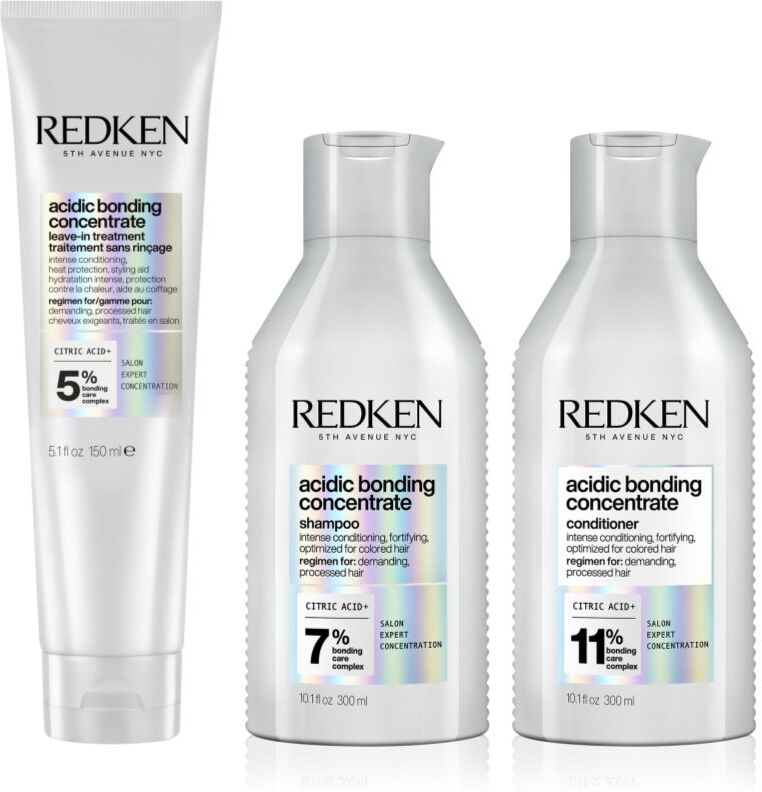
Redken Acidic Bonding Concentrate ensemble pour cheveux abîmésRedken Acidic Bonding Concentrate, 1 pcs, Après-shampooings sans rinçage pour femme, Découvrez un coffret pratique de produits qui embelliront votre quotidien. Le coffret Redken Acidic Bonding Concentrate facilite votre choix, en proposant une sélection de vos articles préférés, désormais réunis dans un seul et même emballage. L'ensemble contient: Redken Acidic Bonding Concentrate shampoing fortifiant pour cheveux affaiblis 300.00 ml Redken Acidic Bonding Concentrate après-shampoing régénération intense 300.00 ml Redken Acidic Bonding Concentrate soin fortifiant sans rinçage 150.00 ml Mode d’emploi : Suivez les instructions indiquées sur l’emballage.84,80 €*Shipping: 3,45 €Secure redirect to the provider
-
Redken Acidic Bonding Concentrate coffret cadeau effet régénérantRedken Acidic Bonding Concentrate, , Baumes et lotions pour cheveux pour femme, Tout ce dont vous avez besoin pour obtenir de beaux cheveux réuni dans un seul emballage. Le coffret cosmétique Redken Acidic Bonding Concentrate renferme non pas un mais plusieurs produits qui permettent de créer ou d’enrichir votre routine capillaire du quotidien. Ce coffret rempli de soins capillaires fera votre bonheur ou celui de vos proches si vous leur offrez un cadeau. L'ensemble contient: Redken Acidic Bonding Concentrate shampoing fortifiant pour cheveux affaiblis 300 ml Redken Acidic Bonding Concentrate après-shampoing régénération intense 300 ml Redken Acidic Bonding Concentrate soin fortifiant sans rinçage 150 ml Le produit : pour les cheveux abîmés pour les cheveux colorés pour les cheveux blonds et décolorés garantit aux cheveux un aspect naturel et les garde en bonne santé protège contre les agressions extérieures régénère et nourrit les cheveux laisse vos cheveux magnifiquement brillants et pleins de vitalité renforce la fibre capillaire Mode d’emploi : Utilisez chaque produit contenu dans le coffret cosmétique en respectant les instructions fournies dans le mode d’emploi.79,80 €*Shipping: 3,45 €Secure redirect to the provider
-
Kallos KJMN Professional Hydrogen Peroxide révélateur 12% 40 Vol. à usage professionnel 1000 mlKallos KJMN Professional Hydrogen Peroxide, 1000 ml, Émulsions activatrices pour femme, Obtenez un résultat parfait lorsque vous vous teintez les cheveux. L’émulsion activatrice Kallos KJMN Professional Hydrogen Peroxide fait fonction d’agent oxydant ou de révélateur lors des colorations. Lorsqu’elle est utilisée dans les bonnes proportions avec une coloration permanente, elle permet de couvrir uniformément les cheveux, d’accentuer nettement la teinte et son éclat et, de ce fait, d’obtenir un résultat plus intense. Grâce à son action sur la consistance du mélange colorant, elle garantit également une application plus précise. Le produit : agit comme agent oxydant lors de la coloration des cheveux Mode d’emploi : Pour usage professionnel uniquement.7,20 €*Shipping: 3,45 €Secure redirect to the provider
-
Can hydrogen bonding occur between hydrogen fluoride (HF) and water (H2O)?
Yes, hydrogen bonding can occur between hydrogen fluoride (HF) and water (H2O). Both HF and water molecules have hydrogen atoms bonded to highly electronegative atoms (fluorine and oxygen, respectively), creating a partial positive charge on the hydrogen atoms. This allows for hydrogen bonding to occur between the partially positive hydrogen atoms of HF and the partially negative oxygen atoms of water. Therefore, HF and water can form hydrogen bonds with each other. **
-
Why is there no hydrogen bonding in HI?
There is no hydrogen bonding in HI because hydrogen bonding occurs between hydrogen and highly electronegative elements like oxygen, nitrogen, or fluorine. In HI, hydrogen is bonded to iodine, which is less electronegative than oxygen, nitrogen, or fluorine. Therefore, the hydrogen in HI does not have a strong enough partial positive charge to form hydrogen bonds with other molecules. **
-
Why are there 3 points in hydrogen bonding?
There are 3 points in hydrogen bonding because it involves the attraction between a hydrogen atom bonded to an electronegative atom (such as oxygen or nitrogen) and another electronegative atom. The hydrogen atom acts as a bridge between the two electronegative atoms, creating a strong dipole-dipole interaction. This interaction results in a partial positive charge on the hydrogen atom and a partial negative charge on the electronegative atom, leading to the formation of a hydrogen bond. **
-
Does hydrogen bonding also occur in methane (CH4)?
No, hydrogen bonding does not occur in methane (CH4). Hydrogen bonding occurs when hydrogen atoms are bonded to highly electronegative atoms such as oxygen, nitrogen, or fluorine. In methane, the hydrogen atoms are bonded to carbon, which is not electronegative enough to form hydrogen bonds. Therefore, methane does not exhibit hydrogen bonding. **
Similar search terms for Hydrogen bonding
-
Kallos KJMN Professional Hydrogen Peroxide révélateur 3% 10 Vol. à usage professionnel 100 mlKallos KJMN Professional Hydrogen Peroxide, 100 ml, Émulsions activatrices pour femme, Obtenez un résultat parfait lorsque vous vous teintez les cheveux. L’émulsion activatrice Kallos KJMN Professional Hydrogen Peroxide fait fonction d’agent oxydant ou de révélateur lors des colorations. Lorsqu’elle est utilisée dans les bonnes proportions avec une coloration permanente, elle permet de couvrir uniformément les cheveux, d’accentuer nettement la teinte et son éclat et, de ce fait, d’obtenir un résultat plus intense. Grâce à son action sur la consistance du mélange colorant, elle garantit également une application plus précise. Le produit : agit comme agent oxydant lors de la coloration des cheveux Mode d’emploi : Pour usage professionnel uniquement.2,40 €*Shipping: 3,45 €Secure redirect to the provider
-
Kallos KJMN Professional Hydrogen Peroxide révélateur 12% 40 Vol. à usage professionnel 150 mlKallos KJMN Professional Hydrogen Peroxide, 150 ml, Émulsions activatrices pour femme, Obtenez un résultat parfait lorsque vous vous teintez les cheveux. L’émulsion activatrice Kallos KJMN Professional Hydrogen Peroxide fait fonction d’agent oxydant ou de révélateur lors des colorations. Lorsqu’elle est utilisée dans les bonnes proportions avec une coloration permanente, elle permet de couvrir uniformément les cheveux, d’accentuer nettement la teinte et son éclat et, de ce fait, d’obtenir un résultat plus intense. Grâce à son action sur la consistance du mélange colorant, elle garantit également une application plus précise. Le produit : agit comme agent oxydant lors de la coloration des cheveux Mode d’emploi : Pour usage professionnel uniquement.1,68 €*Shipping: 3,45 €Secure redirect to the provider
-
Sachajuan Hair Bonding Booster Activator activateur cheveux 30 mlSachajuan Hair Bonding Booster Activator, 30 ml, Sérums capillaires pour femme, Ayez de beaux cheveux des racines aux pointes. Le sérum Sachajuan Hair Bonding Booster Activator soigne parfaitement les cheveux et leur donne une nouvelle vie. Le produit : redonne de la force aux cheveux lisse la surface des cheveux redonne leur brillance naturelle aux cheveux ne sollicite pas les cheveux Mode d’emploi : Appliquez sur les cheveux humides qui viennent d’être lavés aux shampoing. Laissez agir pendant quelques minutes.24,21 €*Shipping: 3,45 €Secure redirect to the provider
-
Kallos KJMN Professional Hydrogen Peroxide révélateur 6% 20 Vol. à usage professionnel 100 mlKallos KJMN Professional Hydrogen Peroxide, 100 ml, Émulsions activatrices pour femme, Obtenez un résultat parfait lorsque vous vous teintez les cheveux. L’émulsion activatrice Kallos KJMN Professional Hydrogen Peroxide fait fonction d’agent oxydant ou de révélateur lors des colorations. Lorsqu’elle est utilisée dans les bonnes proportions avec une coloration permanente, elle permet de couvrir uniformément les cheveux, d’accentuer nettement la teinte et son éclat et, de ce fait, d’obtenir un résultat plus intense. Grâce à son action sur la consistance du mélange colorant, elle garantit également une application plus précise. Le produit : agit comme agent oxydant lors de la coloration des cheveux Mode d’emploi : Pour usage professionnel uniquement.1,76 €*Shipping: 3,45 €Secure redirect to the provider
-
What is the difference between hydrogen bonding and dipole-dipole interactions?
Hydrogen bonding is a specific type of dipole-dipole interaction that occurs between a hydrogen atom bonded to a highly electronegative atom (such as oxygen, nitrogen, or fluorine) and another electronegative atom in a different molecule. This type of interaction is stronger than regular dipole-dipole interactions because of the large electronegativity difference between the hydrogen and the other atom, resulting in a stronger attraction between the molecules. In contrast, dipole-dipole interactions occur between the positive end of one polar molecule and the negative end of another polar molecule, but do not involve a hydrogen atom bonded to a highly electronegative atom. **
-
Is the density anomaly of water the result of hydrogen bonding?
Yes, the density anomaly of water is the result of hydrogen bonding. When water is cooled below 4°C, the hydrogen bonds between water molecules start to form a more open and organized structure, causing the density of water to decrease. This is why ice is less dense than liquid water. The unique arrangement of hydrogen bonds in water is what gives it its unusual density behavior, making it one of the few substances that becomes less dense when it solidifies. **
-
What does a concept map for hydrogen bonding in chemistry look like?
A concept map for hydrogen bonding in chemistry would typically include the central concept of hydrogen bonding, with branches extending to related concepts such as electronegativity, polarity, and intermolecular forces. It would also include specific examples of molecules that exhibit hydrogen bonding, such as water, ammonia, and alcohols. The map would visually show the connections between these concepts and how they relate to the phenomenon of hydrogen bonding in chemistry. Additionally, it may include arrows or lines to indicate the direction of influence or relationship between the different concepts. **
-
Can you explain hydrogen bonding and Van der Waals forces using examples?
Hydrogen bonding occurs when a hydrogen atom is covalently bonded to a highly electronegative atom (such as oxygen, nitrogen, or fluorine) and is also attracted to another electronegative atom. This creates a strong dipole-dipole interaction, resulting in a relatively strong bond. An example of hydrogen bonding is the interaction between water molecules, where the hydrogen atoms are attracted to the oxygen atoms of neighboring water molecules. Van der Waals forces, on the other hand, are weak intermolecular forces that occur between all molecules. They are caused by fluctuations in electron distribution within molecules, leading to temporary dipoles. An example of Van der Waals forces is the interaction between nonpolar molecules, such as the forces between methane molecules. In summary, hydrogen bonding is a relatively strong intermolecular force that occurs in molecules with hydrogen atoms bonded to highly electronegative atoms, while Van der Waals forces are weaker forces that occur in all molecules due **
* All prices are inclusive of VAT and, if applicable, plus shipping costs. The offer information is based on the details provided by the respective shop and is updated through automated processes. Real-time updates do not occur, so deviations can occur in individual cases. ** Note: Parts of this content were created by AI.